
In October, Alter Development marks its fifth anniversary. Over these five years, the company has evolved from working with a portfolio of four historic buildings in Kharkiv to developing a comprehensive approach to restoration and revitalization projects.
We started with a very specific task: not simply to work with historic buildings, but to create viable development models for them. This requires a comprehensive approach — from concept and architecture to legal, financial and operational matters.
Today, Alter remains focused on restoration and revitalization, but operates in a different environment and is looking for opportunities beyond Kharkiv. At the same time, the company is entering a new stage of management: in October, I will hand over the CEO responsibilities to Pavlo Ihnatenko, who has led Alter’s construction division for almost five years.
For me, this is not a sudden change, but a natural stage in the company’s development.
Alter Development was legally established in 2021, although we began bringing investors together around the future portfolio back in 2020. At the time, it consisted of four buildings: the Doctor Mangubi`s House, Faninskyi Quarter, the Lazar Rosenfeld House, and the Yakovlev Printing House.
It quickly became clear that, for an investor, simply owning such assets does not create their value. These are complex real estate assets with both financial and reputational implications. That created the need for Alter Development as a company capable of taking a comprehensive approach to every aspect of a project — from revitalization concepts and legal and financial matters to marketing, engagement with municipal authorities.
At the time, I did not have specific experience in development, but I had a background in finance and management. I have always followed a simple principle: if I lack the knowledge needed to make a decision, I go and acquire it. Alongside building the company, I studied at ULPM School, a professional development school, where I gained not only new knowledge but also important professional connections.
This is how the Alter team and our approach to development gradually took shape.
One of Alter’s key ideas from the very beginning was to determine the future function of an asset ourselves. This build-to-suit approach remains relatively uncommon in the Ukrainian market.
Whether a building becomes an office space, medical facility, hotel, coworking space or serves another function is a decision that needs to be made before work begins on the architectural concept.
This, in turn, defines the task for the architects: what needs to be preserved, what can be adapted, which engineering solutions are required and how the space should be organized.
Over the past five years, we have worked with a large number of architectural firms and other professional partners. This has also become an important part of our experience: we have learned how to work with different teams, align architectural solutions with business models and take projects through to completion.
At the beginning of the full-scale invasion, the team evacuated to Khmelnytskyi, and the company suspended its operations for several months. For three months, we tried to maintain the buildings’ operations at a minimum level.
The team then proposed returning to Kharkiv and resuming work. For me, this was not an easy decision, as it involved a direct risk to people’s lives. But the team’s motivation — and the fact that the initiative to return came from them — helped me make that decision.
In development, putting a process on hold often means that some of the value of the work already completed is lost, while the cost of completing the project increases. We decided to finish what had already been started.
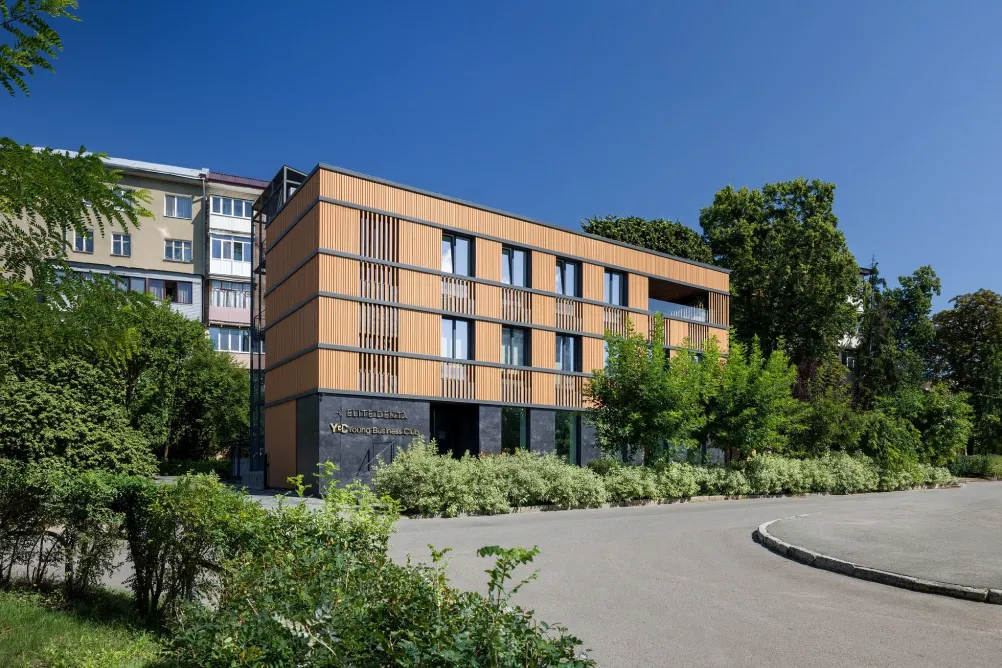
I would also like to highlight one of the tenants of Faninskyi Quarter, which has been there since 2021: Elite Denta dental clinic. After a pause, they resumed operations in June 2022. For us, this was another sign that life in Kharkiv was continuing.
Another important stage was the restoration of the complex of buildings on Chornohlazivska Street — the Lazar Rosenfeld House and its annex. Completing projects of this kind during a full-scale war was difficult, but it was important for us to bring them through to commissioning. An unfinished building remains a liability in an investor’s portfolio. It cannot be fully used: it cannot be leased, insured or sold.
So our task was “simple”: to complete the work and turn the building into an asset.
Insurance against war risks was another challenge. We immediately began looking for insurance options and instruments for our assets. At the time, there were very few comparable cases in Ukraine, and insuring assets in Kharkiv was hardly an option.
Within six months, together with the team, we found an insurance partner and developed such a mechanism. We have renewed the agreement every year since.
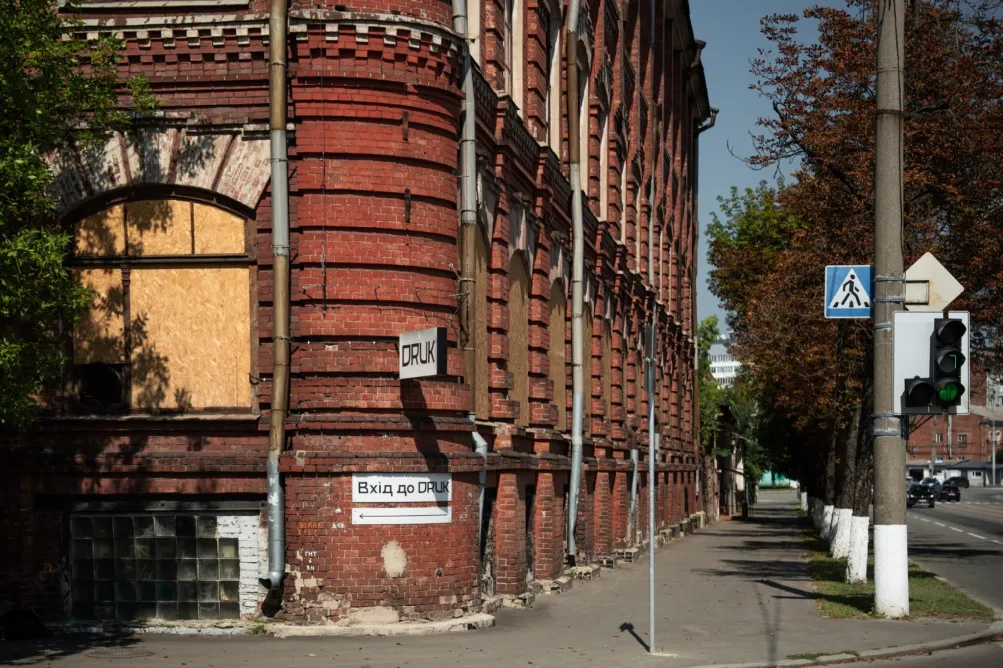
I would single out one of Alter Development’s objects in particular — the Yakovlev Printing House.
Before the full-scale invasion, we were still looking for the optimal concept for the building. We worked with different architects and concept-makers, studied the building itself and the surrounding neighborhood. It was important to understand who lived there, how people moved around the area, what the neighborhood was missing and how it could develop.
Eventually, we arrived at the idea of a multifunctional space with exhibition and event areas, a hotel, hostel, food court and coworking space.
But February 24, 2022 changed the context. The research and scanning of the building had been completed literally a few days before the full-scale invasion began. During this period, both society and my own understanding of why we create such projects changed.
This is how the idea of the DRUK cultural and civic center emerged — a space that was conceived as a tool for challenging the sense of cultural inferiority. We needed a place where people could see and experience Ukrainian culture in all its forms as a distinct world with its own influence, history and future. Today, the space hosts projects and artists working with contemporary Ukrainian culture, architectural heritage and intangible heritage.
At the same time, it is important for me to distinguish between two things: the building and the cultural center. The cultural center can exist in another building, while the Yakovlev Printing House can have a different function. For now, the two coexist, and we want to preserve that going forward.
We prepared part of the premises for operation and created the Mystetske Ukryttia — a safe space for cultural events. The restoration project for the building itself is already complete and waiting for the right time. As originally planned, after restoration the Yakovlev Printing House will become a multifunctional complex with spaces for cultural and business events. The DRUK cultural and civic center also has its place within this project.
For me, DRUK became an example of how development can respond to changes in society without losing its connection to the architecture and history of a building.
Today, the company faces a different set of challenges: people, logistics, regulatory and bureaucratic issues.
For historic buildings, one of the particular challenges is reconciling modern safety requirements, including DBN standards, with the need to preserve their architecture and make projects economically viable. If certain requirements are applied literally to existing historic buildings, the cost of adapting them can increase to a point where a project becomes impossible to implement.
As a business, we still have to find the right balance between safety, heritage preservation and project economics.
At the same time, it has become clear that Alter Development’s future growth cannot currently be tied to Kharkiv alone. We are looking for new projects and partners in other regions who share our approach to restoration, revitalization, and working with historic buildings and heritage.
From the very beginning, I understood that no role within a company should be permanent. One of my principles as a manager is to develop people within the team so that, when the time comes, they are ready to take on greater responsibility.
That is why the decision to hand over the CEO responsibilities is a natural stage in Alter Development’s evolution. I have worked for a long time to ensure that the company has someone who knows its processes, team, contractors and projects from the inside.
That person will be Pavlo Ihnatenko. He has been with Alter Development since the company was established and has led the construction division throughout this time. During this period, he has gone through the challenging process of delivering our projects alongside the company and understands how the business works.
Alter’s focus remains unchanged: restoration, revitalization and the creation of long-term development models for historic and architectural landmarks and significant buildings.
Over five years, we have gained enough experience to understand the complexity of this task. The next stage is to apply this experience more broadly, including to the reconstruction of buildings damaged by the war. To work in new regions and continue building a company capable of taking on the full development cycle for such projects.